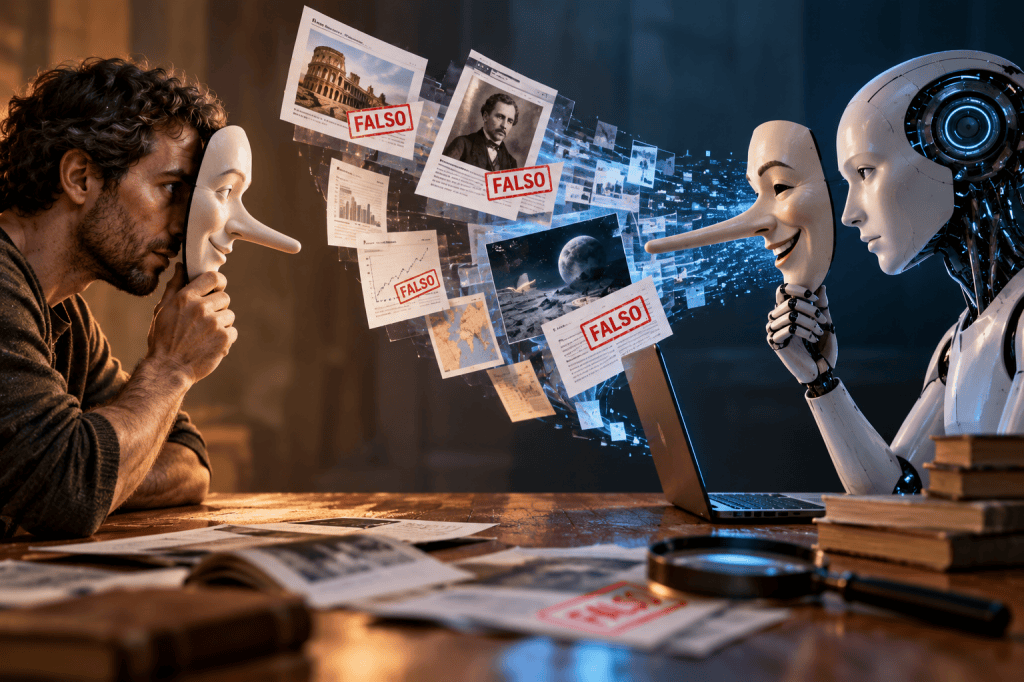
Can someone who does not know what truth is actually lie? Nearly two thousand years ago, Epictetus reflected on one of the most human of contradictions: how can we come to accept as true what we want to believe, even when reality gives us reasons to doubt it?
The Stoic philosopher Epictetus knew nothing of computers, algorithms, or, much less, artificial intelligence. Yet some of his reflections on judgment, truth, and self-deception seem surprisingly relevant today.
There is one idea from Epictetus that particularly interests me. In his Discourses, recorded by his disciple Flavius Arrian during the early decades of the second century AD, he argues that the human mind naturally rejects contradiction, yet can hold contradictory beliefs as long as it remains unaware of them. In other words, we are capable of defending something false without recognising our own mistake.
And this brings me to a question that has been on my mind for some time. What is the difference between a person who lies and an artificial intelligence system that invents an answer and presents it to us as if it were true?
At first glance, the result may be identical. We receive false information, believe it to be true, and sometimes make decisions based on it. But what lies behind that falsehood is radically different.
A person may lie out of fear, self-interest, satisfaction, shame, or simply to avoid an uncomfortable situation. They may know the truth perfectly well and deliberately choose to conceal it. They may also deceive themselves until they end up believing their own version of events. We are remarkably good at doing the latter, although we find it difficult to admit.
Artificial intelligence, by contrast, does not need to know the truth to produce an apparent lie. When a generative AI system hallucinates, it may fabricate a quotation, attribute a statement to someone who never made it, construct an incorrect scientific explanation, or describe events that never happened. And it can do so with disconcerting confidence.
It does not hesitate. It does not blush. It does not feel the discomfort of someone who knows they are being dishonest. But neither do we have grounds to attribute to it, on the basis of this behaviour, a conscious intention to deceive us. Current AI models generate responses through computational processes that are not equivalent to human beliefs, intentions, or moral consciousness.
This is why I believe we need to distinguish between two concepts that we often confuse: lying and falsehood. Every deliberate lie involves an intention to deceive, but not every falsehood is a lie.
It seems like a simple distinction. Yet when applied to artificial intelligence, it has important consequences. For centuries, we have learned to interpret human communication by considering who is speaking to us, what interests they have, what they know, and why they might want to deceive us. We have developed a certain instinct for questioning some claims. It does not always work, of course, but it is part of our social experience.
Artificial intelligence introduces something different. We are confronted with systems capable of constructing extraordinarily convincing explanations, without that ability guaranteeing the truth of what they say. And our brains are not always prepared to distinguish between the two.
A well-written, structured, detailed, and confidently expressed answer gives us an impression of knowledge. If, in addition, it comes from a technology we associate with millions of data points and enormous processing power, we find it even easier to trust it. We confuse the quality of an explanation with the quality of the information behind it.
I believe this is one of the greatest cognitive risks posed by artificial intelligence. Not because people are incapable of thinking critically, but because we are accustomed to associating coherent language with the presence of someone who understands what they are saying. With AI, that connection can no longer be taken for granted.
And this brings me back to Epictetus. The philosopher insisted on the importance of examining our judgments before accepting them. It is not events themselves that determine our interpretation of reality, but the judgments we form about those events. An idea that takes on a new dimension today.
Because we are no longer examining only our own thoughts or the statements of other people. We must now also learn to scrutinise the responses of machines that can express themselves with remarkable linguistic precision while, at the same time, being completely wrong.
But there is another question that concerns me even more. If a machine does not know it is lying, who is responsible for its lies?
Imagine a company developing an artificial intelligence system to support medical, legal, or financial decision-making. Those responsible know that the system can fabricate information. They understand its limitations and are aware that some of its answers may be incorrect. Despite this, they decide to market it as a reliable tool without adequately explaining those risks. The machine may be generating a falsehood without any intention to deceive. But the people who know its limitations and choose to conceal them are operating on very different moral ground.
Here, responsibility becomes profoundly human once again. We cannot demand moral honesty from an algorithm in the same way we demand it from a person. But we can demand it from those who design it, market it, integrate it into organisations, and decide how much autonomy to grant it. And we must also expect a certain degree of responsibility from ourselves as users.
There is little point in demanding responsible artificial intelligence if we are willing to accept any answer that confirms what we already believe. This behaviour, incidentally, takes us back to one of Epictetus’s longstanding concerns: our tendency to confuse what we believe with what we know.
Perhaps AI has not created a new problem. Perhaps it has amplified, on an unprecedented scale, a weakness that has always been part of the way we think. We like being right. Uncertainty makes us uncomfortable. And an immediate, convincing, apparently well-founded answer is far more appealing than admitting that there is something we still do not know. That is why I consider it so important for artificial intelligence systems to learn to communicate their limitations, acknowledge uncertainty, and, when necessary, simply respond: “I don’t know.”
For years, we have measured technological progress by the ability of machines to provide answers. Perhaps we should also begin to value their ability to refrain from answering when they lack sufficient grounds to do so.
An artificial intelligence system that acknowledges its limitations may seem less impressive, but it will probably be far more useful in building a relationship of trust with people. And that trust should not be based on the appearance of intelligence, but on our ability to verify what we are told, correct mistakes, and know who takes responsibility when something goes wrong.
There is a fundamental difference between making a mistake, lying, and knowingly allowing other people to be deceived. If we cannot distinguish between them, we risk transferring to machines responsibilities that still belong to human beings. Epictetus placed human freedom in our ability to govern our own judgments. Almost two thousand years later, artificial intelligence confronts us with a new difficulty: an increasing share of the information we use to form those judgments comes from systems that can generate statements without understanding them as we do.
I do not believe the answer is to distrust all technology. It would be absurd to turn our backs on a tool with so much potential to improve knowledge, work, and people’s lives. But neither can we confuse its ability to produce language with unquestionable authority over the truth.
Ultimately, there is something that no technological revolution should ever make us forget. A machine can be wrong without knowing it. A person can lie while knowing exactly what they are doing. But when someone knowingly exploits a machine’s ability to generate falsehoods in order to deceive others, the lie once again has a human being behind it.
And perhaps this is the question we should be asking ourselves more often: not whether artificial intelligence is capable of lying, but whether we are being sufficiently honest about what it is actually capable of doing.
Because technology may radically change the way we access knowledge, but the responsibility for distinguishing between what is true, what is false, and what we simply want to believe remains ours.
Sergi Marcén i López


Deixa un comentari