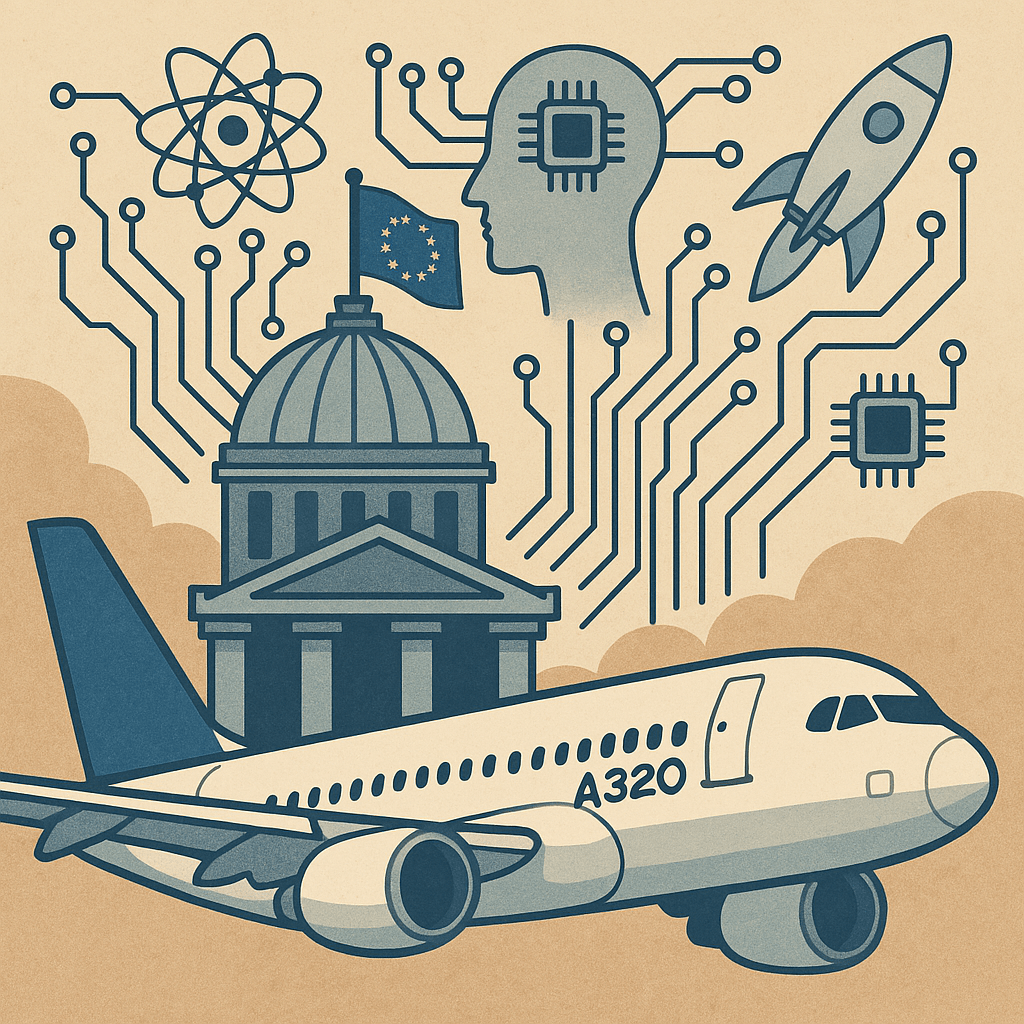
In the second half of the 20th century, Europe did the unthinkable. In an act of political courage and strategic ambition, the main countries of the continent — France, Germany, the United Kingdom, and Spain — decided to unite to challenge the giants of American civil aviation: Boeing, McDonnell Douglas, and Lockheed. This is how Airbus was born, not as a mere aeronautical company, but as a continental response to a technological and economic hegemony that threatened to reduce Europe to a secondary role in the history of industrial progress.
Today, half a century later, Europe finds itself at a similar — yet far more decisive — crossroads. The race for artificial intelligence, quantum computing, biotechnologies, microchips, and autonomous systems is not just a technological contest: it is the foundation upon which our welfare society will either be built or collapse.
And so the urgent question arises: Where is Europe’s DARPA?
The Defense Advanced Research Projects Agency (DARPA) was created in 1958, in response to the strategic and psychological shock caused by the launch of Sputnik by the Soviet Union. It was the first major blow to American exceptionalism in the midst of the Cold War. The United States’ response was not merely to increase military spending: it was to create a radically innovative institution to ensure that no scientific breakthrough would ever catch them off guard again.
Since then, DARPA has been the incubator of the technologies that define our world: the ARPANET (precursor to the Internet), GPS, military drones, virtual assistants, autonomous navigation systems… But its real secret lies not only in its technical capacity, but in its institutional model: bold-vision projects, led by scientists and managers with freedom, agile funding, high-risk objectives, and a collaborative ecosystem that brings together defense, science, industry, and civil society.
DARPA was not only created to protect the United States — it helped to consolidate its economic and cultural hegemony. Today’s digital dominance by Silicon Valley and Big Tech is rooted in DARPA’s strategic investments during the 1960s, 70s, and 80s.
Today, Europe is experiencing a new Sputnik moment. The war in Ukraine has shattered long-standing taboos around defense spending. Countries like Germany, traditionally reluctant to rearm, have declared a Zeitenwende — a turning point — and approved historic security budgets. France reaffirms its doctrine of strategic autonomy. And the European Commission, for the first time in its history, is calling for a robust European defense industry.
But the battlefield is no longer merely physical. 21st-century warfare is also digital, algorithmic, cyber, energetic, and cognitive. Europe’s defense cannot rely solely on tanks and fighter jets; it requires autonomous decision systems, sovereign AI, independent satellites, secure quantum networks, and European tech platforms. And that is not built by purchasing foreign technology — it is built by investing in strategic innovation of our own.
Creating a European DARPA would be to digital transformation what Airbus was to civil aviation: a declaration of sovereignty, a bet on knowledge as the foundation of power, and a long-term investment in the freedom of our democracies.
This agency must not become another bureaucratic replica or just another EU body. It must be a lightweight, autonomous, technocratic, and results-oriented structure, capable of hiring the best talent, taking risks, failing without fear, and succeeding through disruption. Its mission must be not only military but strategic: ensuring that Europe does not depend on others for the critical technologies that uphold its economic model, political autonomy, and social contract.
Because without technological sovereignty, there is no political sovereignty — and without political sovereignty, there is no democracy. And without democracy, we cannot preserve a European model based on the welfare state, social cohesion, labor rights, and respect for freedoms.
History shows us that Europe is capable of great feats when it understands its survival is at stake. It was so with Airbus. It was so with the creation of the euro. And it must be so now, with artificial intelligence, digital defense, and technological sovereignty.
The goal is not to imitate DARPA, but to create a European version adapted to our strengths: scientific diversity, humanist spirit, academic talent, robust industry, and shared vision.
A European DARPA is not a luxury. It is a strategic instrument for survival and transformation. It is the key for Europe to write its own future in its own voice — and not to live it as a footnote in a world dominated by others.
Sergi Marcén Expert in Digital Transformation and Public Digital Policy


Deixa un comentari