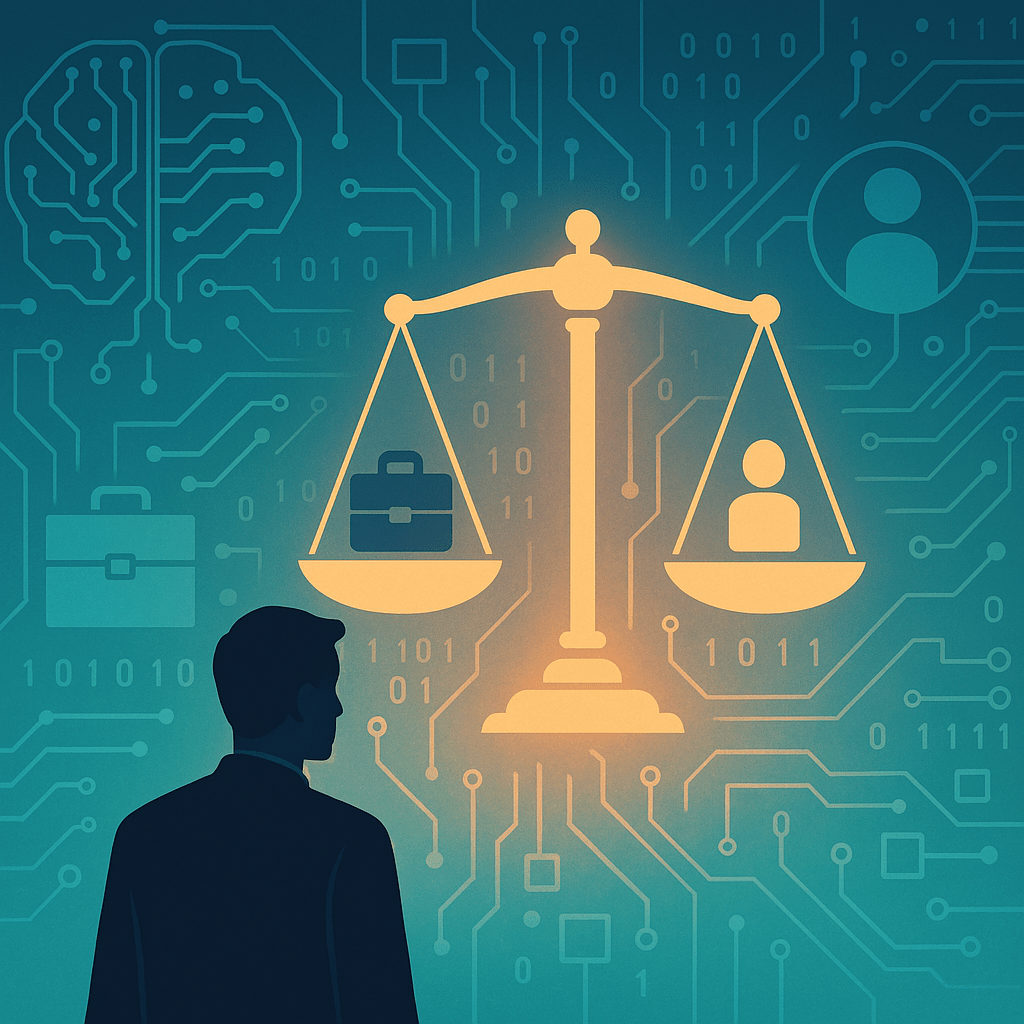
We are living in a decisive moment. Technology is advancing at an unstoppable pace, transforming every aspect of our lives — from how we communicate to how we work. But while we marvel at artificial intelligence, automation, and remote work, there is a crucial question we cannot ignore: is digital justice keeping pace with this new world of work?
Because yes, algorithms already decide who gets interviewed, what tasks are assigned, and in some cases, even who gets fired. Digital platforms manage thousands of workers without offices, without fixed schedules, and in many cases, without rights. This phenomenon is clearly visible across multiple sectors and platforms. For example, in the case of Uber, drivers operate as “independent partners,” with no access to social benefits or full labor rights, even though the app imposes strict performance and availability guidelines. A landmark ruling by the UK Supreme Court in 2021 determined that these workers, despite their supposed autonomy, must be considered employees entitled to minimum wage and paid holidays.
Similar situations are repeated in delivery platforms like Glovo, Deliveroo, or Uber Eats, where couriers are subject to ratings, penalties, and algorithms that tightly control their performance. In Spain, the enactment of the Rider Law in 2021 forced these companies to formally recognize an employment relationship with their riders, setting a precedent in Europe.
Beyond physical work, there are also forms of digital precarity in platforms like Amazon Mechanical Turk, where thousands of people perform virtual microtasks — classifying images, verifying data, or training algorithms — for just a few cents, without any kind of contract or safety net. It’s an extreme form of labor fragmentation, where digital invisibility makes collective organization or legal defense nearly impossible.
Freelance marketplaces like Fiverr or Upwork are no exception. Programmers, designers, or writers compete in a global market where supposed worker empowerment often hides power imbalances, depressed rates due to algorithmic competition, and vulnerability to non-payment or unilateral cancellations. Digital reputation is everything — a single bad rating can end a professional career with no right to reply.
In Latin America, Rappi offers another paradigmatic example. Although couriers are formally self-employed, they must constantly accept orders and maintain performance indicators to keep their spot on the platform. Many work without insurance, without guaranteed minimum income, and are exposed to both physical and economic risks on a daily basis.
These examples show how the “flexibility” promoted by digital platforms often shifts all the risk onto workers, weakening the very concept of the labor contract. In this context, digital justice must be able to make these new forms of inequality visible, scrutinize them, and correct them — even when they don’t fit into traditional legal categories, but deeply affect the rights and dignity of millions of people.
Faced with all this, justice — that republican pillar that should guarantee equity, participation, and protection — needs urgent transformation. Digitalizing justice is not about scanning files or putting forms online. It’s about rethinking the entire system from scratch. In a society where work is managed by automated systems and artificial intelligence actively participates in key decisions, access to transparent, fair, and understandable justice becomes indispensable.
A recent study by Chander et al. (2023) warns that algorithms can amplify structural biases if not carefully designed and supervised. And we’re not talking about science fiction — we’re already seeing this every day in hiring processes, task allocation, and performance evaluations in major tech companies.
The so-called gig economy — this on-demand work economy managed through apps — has been sold as a symbol of freedom. However, in many cases, it has led to precarious working conditions, algorithmic surveillance, and the erosion of labor rights. De Stefano and Wouters (2022) make it clear: many platform workers don’t even have a channel to challenge unfair decisions. Meanwhile, automation keeps advancing. According to the Future of Jobs report by the World Economic Forum (2020), by 2025 more than half of the global workforce will need to reskill to remain employable. This transition is no longer optional — it is urgent. But if this digital transformation is not accompanied by fair public policies, what awaits us is not a more efficient economy, but a more unequal society. The risk is the creation of a new digital underclass, without protection, without collective bargaining, and without justice.
This is where a fundamental idea comes into play: digital justice cannot just be faster or cheaper — it must be fairer. How? By acknowledging that labor disputes are no longer resolved solely in physical courts. Online mediation, digital conflict resolution, and oversight of labor algorithms must become central functions of modern judicial systems.
Here’s a striking fact: Zhang et al. (2025) showed that AI models applied in labor processes often reached correct decisions, but based on faulty reasoning. In other words, the results may seem fair, but the logic behind them is opaque, inconsistent, or unjust. How can a worker appeal a decision if they don’t even understand how it was made?
The answer lies in demanding algorithmic transparency, explainability of automated systems, and the right to human oversight. Because automation should never mean dehumanization. In 2019, the European Union passed the Directive on Transparent and Predictable Working Conditions (2019/1152), a key step that obliges companies to explain how algorithms are used in labor management. But as always, laws are only effective if institutions enforce them. Are we training judges, lawyers, and legal professionals to supervise these new environments? Do workers have tools to exercise their rights on digital platforms? Or are we still applying 20th-century rules to 21st-century conflicts?
One of the fastest-growing areas of artificial intelligence is recruitment. From automated résumé screening to virtual interviews using facial recognition, companies seek efficiency — but may be reinforcing biases without realizing it. The study by Binns et al. (2018) found that many automated selection systems replicate gender, racial, or class stereotypes because they are trained on historical data already shaped by inequality. Without ethical audits, independent oversight, and public standards, we are building systems that perpetuate injustice.
A fair transformation cannot rely solely on individual merit. Not everyone starts from the same place. Digital literacy is a collective responsibility. Germany, for example, has launched national training programs with an inclusive approach (Bundesministerium für Bildung und Forschung, 2021). The idea is simple: no one should be left behind because they don’t know how to code or use digital tools.
And although companies like Google or Microsoft have launched global training initiatives, these must complement — not replace — public policies. As Chen and Majchrzak (2023) argue, training in digital skills should be structural policy, not corporate charity. Digital justice must also ensure equitable access to knowledge and job opportunities, guaranteeing that new gaps do not emerge between those who can train digitally and those who cannot.
At the heart of this debate lies a deeper question: power. Because algorithms are not neutral. They are designed by people — with values, interests, and biases. And in most cases, they are not subject to public scrutiny. Who decides what parameters are used to screen candidates? Who monitors the system that recommends promotions or calculates bonuses? What institutions can intervene when something goes wrong?
These questions, although technical on the surface, are profoundly political. And digital justice must have the capacity — and the courage — to ask them, answer them, and act accordingly. Because if it doesn’t, the risk is clear: that the future of work will be governed by opaque algorithms designed to maximize corporate profits, not to protect human rights.
The good news is that there’s still time to change direction. Digital transformation is not set in stone — it is a human construction. And that means we can decide where we want it to go. A republican digital justice — one that defends the public interest, limits the abuse of power, and fosters civic participation — is not a utopia. It is an urgent necessity. We need institutions that regulate, that educate, that transform. Institutions that confront platforms when they violate rights and that protect citizens even when they don’t fully understand how the system works.
Ultimately, this is about renewing the social contract so that in this new era of digital work, labor dignity, equal opportunity, and justice are not empty words — but tangible realities.
Sergi Marcén López, Expert in Digital Transformation and Public Digital Policy


Deixa un comentari