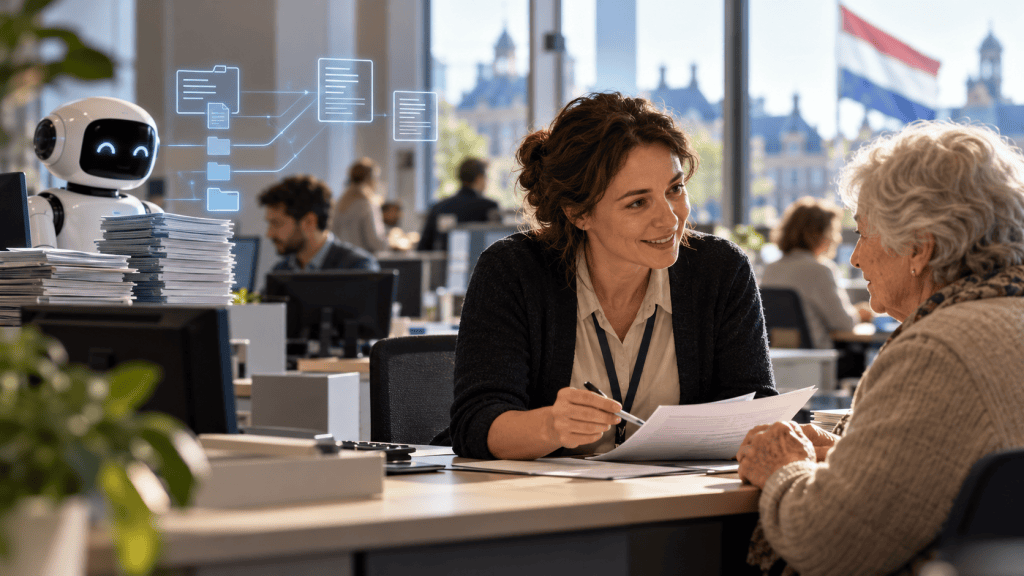
The Dutch government wants to reduce the size of its public administration, relying in part on artificial intelligence. But perhaps we are asking the wrong question: what if we used this technology to give public employees more time to care for the people they serve?
The Dutch government has announced a plan to reduce the size of its public administration. It envisages cutting around 25,000 full-time equivalent positions over the coming years, with annual savings expected to reach €3.5 billion by 2035. Artificial intelligence is among the tools expected to help achieve these goals.
The news made me think about something those of us working in the digital transformation of public administration have been discussing for years: what do we really want technology for?
I understand why a government would want to reduce spending, eliminate duplication and make its organisation more efficient. That is part of its responsibility. What concerns me is the possibility that we may end up applying private-sector logic to public services, where improvements in productivity often translate into lower costs and, frequently, fewer employees.
Public administration is not a private company. And although we have been using the term for years, a citizen is not exactly a customer either.
A company can decide that certain services are no longer profitable, withdraw from a market or concentrate its resources on customers who generate the most revenue. Public administration, on the other hand, has a duty to serve everyone. Including those who need more time, those who struggle to understand an administrative procedure, and those facing personal circumstances that cannot easily be captured in a form.
Think of an elderly person who visits a government office because they have received an official letter they do not understand. Perhaps the administrative procedure itself can be completed in five minutes, but that person needs twenty minutes to explain what worries them, what they have understood and what they fear might happen next. Are those additional fifteen minutes a loss of productivity?
To me, they are precisely what gives public service its value.
Over more than three decades working in information technology, I have seen how we have gradually introduced computer systems into public administration with the promise of simplifying the way it works. We have made significant progress, and it would be absurd to deny that. But we have also created a digital bureaucracy that is sometimes just as complicated as the one we intended to replace.
There are public employees who spend much of their working day switching between applications, searching for documents, copying information from one system to another, drafting reports or trying to find out what stage a particular case has reached. We have digitised countless procedures without sufficiently questioning whether those procedures made sense in the first place.
Meanwhile, citizens are still waiting.
Artificial intelligence offers us an opportunity we should not waste. We can make sure that many of these administrative tasks no longer consume such a large proportion of public employees’ time. We can develop assistants that retrieve information, prepare documents, help interpret regulations, identify relevant case histories and make administrative processes easier to manage.
But the really interesting question comes afterwards.
What do we do with the time we have freed up?
Imagine a social worker who currently spends a significant part of their day preparing case files, consulting information and completing paperwork. If artificial intelligence allows us to cut that workload in half, we have two options. We can conclude that we need fewer social workers, or we can enable them to spend more time with the families they support.
I have a pretty clear idea of where the real public value of that improvement lies.
And I am not talking about artificially preserving jobs or defending administrative structures that no longer serve a purpose. Public administration must manage taxpayers’ money responsibly. But eliminating unnecessary work is one thing. Assuming that the main benefit of doing so is reducing the number of people delivering public services is something quite different.
There is something about this view of productivity that particularly concerns me. We have become accustomed to measuring what is easy to count: cases resolved, average processing times, number of requests handled or cost per procedure. These are necessary indicators, but they tell us very little about how someone felt when dealing with public administration, or whether we actually understood and solved their problem.
We might enable a civil servant to process twice as many cases in a morning while citizens receive a worse service. We can automate responses, shorten processing times and close requests without ever understanding what the person in front of us really needed.
Public administration should not confuse speed with quality of service.
That is precisely why I believe artificial intelligence can help us recover something we have gradually lost amid procedures, screens and administrative obligations: the ability to listen.
Listening takes time. Understanding someone’s personal circumstances takes time too. And there are public decisions that, however advanced technology becomes, will still require professional judgement, sensitivity and human responsibility.
An algorithm can help identify which benefits a family might be entitled to, but it can hardly understand, on its own, everything it means for that family to be on the verge of losing their home. It can summarise a medical record, but it cannot replace the conversation between a healthcare professional and someone who has just received difficult news. It can explain an administrative decision, but it should not be the one ultimately responsible for decisions affecting a citizen’s rights.
We should also remember that artificial intelligence makes mistakes. It can provide incorrect information, reproduce biases or misinterpret particular circumstances. In public services, where a decision can profoundly affect someone’s life, human oversight is a safeguard we must preserve.
In the AI projects for public administration that I am involved in, one of the questions that interests me most is how we can reduce the cognitive burden on public employees. It is not simply about automating tasks. It is about making technology better understand the context in which people work and providing them with the information they need, when they need it.
A civil servant should not have to consult five different applications to resolve a request. They should be able to quickly understand the background of a case, find the relevant regulation without spending half the morning searching for it, and access reliable information to make a decision and explain it clearly to the citizen concerned.
All that time we currently spend managing administrative complexity could instead be spent on people.
And this brings me to a question I consider fundamental: if we are going to measure the success of artificial intelligence in public services, why don’t we start by measuring how much time for human interaction we have managed to recover?
I would be far more interested in knowing how many additional hours social workers can spend supporting families than how many positions have been eliminated. Or how much care for elderly people has improved, how many unnecessary visits to government offices have been avoided, or how many citizens have managed to solve their problems without having to tell the same story five times.
These outcomes are also productivity. In fact, they are probably a much more accurate measure of the value public administration brings to society.
The debate unfolding in the Netherlands matters because it anticipates a discussion we will face across Europe. Artificial intelligence is going to profoundly change how our institutions operate and how many public employees do their jobs. It would be naive to think otherwise.
But we still have time to decide what we want to do with this technological capability.
We can use it to reproduce existing organisational models, make them faster and reduce their costs. Or we can take the opportunity to rethink how public services should work when they are designed around people’s real needs.
I do not believe we should measure the progress of a public administration by how small it manages to become. I would rather measure it by its ability to solve problems, protect rights and be there when someone needs it.
And if artificial intelligence allows a civil servant to spend less time in front of a screen and more time talking to a citizen, we will have achieved something far more valuable than budget savings.
Because perhaps the greatest technological advance we can offer citizens is, quite simply, to give them back the time and attention of the people whose job it is to serve them.
Sergi Marcén López


Deixa un comentari